
How to Repair Torn Jeans by Hand So They Last
A ripped knee does not have to mean the end of a favourite pair. To repair torn jeans by hand, you only need a few simple tools, a little patience and permission for the repair to show. A visible mend can look thoughtful and characterful; a close colour match can make it quietly disappear. Both are good choices when the jeans fit well and still feel like you.
Hand repair is especially useful when you do not own a sewing machine, when the tear is small, or when you want to strengthen a worn area without changing the shape of the garment. The key is not to pull the torn edges tightly together. Denim needs a little support behind the damage, otherwise the strain simply moves to the next weak spot.
What you need to repair torn jeans by hand
Gather your jeans, sharp fabric scissors, a hand-sewing needle, sewing thread and a denim patch. A scrap cut from old jeans is ideal because it behaves much like the fabric you are repairing. If you have no denim scrap, choose a sturdy cotton fabric that is similar in weight. Avoid anything much lighter, as it can pull away from the jeans over time.
Choose a needle that passes through denim without forcing it. A sharps needle or denim needle works well. For thread, use polyester all-purpose thread for strength, or embroidery floss if you want the stitching to become part of the design. Thread that closely matches the denim is best for a subtle mend, while contrast thread gives a sashiko-inspired, visibly repaired finish.
Before you begin, wash and dry the jeans as you normally would. This removes surface dirt and lets the fabric settle, which is helpful if the tear sits on a knee or another area that has stretched with wear.
Repair torn jeans by hand with a backing patch
For most tears and holes, an inside patch is the most durable approach. It supports the damaged fabric while allowing you to stitch across the surface neatly. This method works beautifully on knees, thighs, pockets and places where the denim has gone thin around a tear.
1. Tidy the damaged area
Turn the jeans inside out and snip away only loose, fraying threads that are clearly detached. Do not cut off the intact threads crossing the tear - they may still help hold the fabric together. If the edges are very ragged, gently press them flat with a warm iron. This makes the shape of the repair easier to see.
Cut a patch that extends at least 2 to 3 cm beyond every side of the tear or worn patch. Rounded corners are a good idea because sharp corners can lift and catch. Place the patch behind the hole, on the inside of the jeans, with the right side of the patch facing the inside of the garment. Pin or baste it in place. Basting is simply a line of large temporary stitches, and it gives you more control than pins when working around a curved knee.
2. Secure the patch first
Thread your needle with a comfortable arm’s length of thread, then knot one end. Start inside the jeans so the knot is hidden between the patch and the denim. Stitch around the edge of the patch using small running stitches or whip stitches. Keep your stitches about 5 mm from the patch edge.
This first row stops the patch shifting. It does not need to be perfectly invisible. Aim for even tension rather than tiny stitches: if you pull too firmly, the knee area can become stiff and pucker when you bend your leg.
3. Stitch over the tear
Turn the jeans right side out. Bring the torn edges close together, but do not overlap them or tug them until they meet. They should rest naturally on the patch beneath.
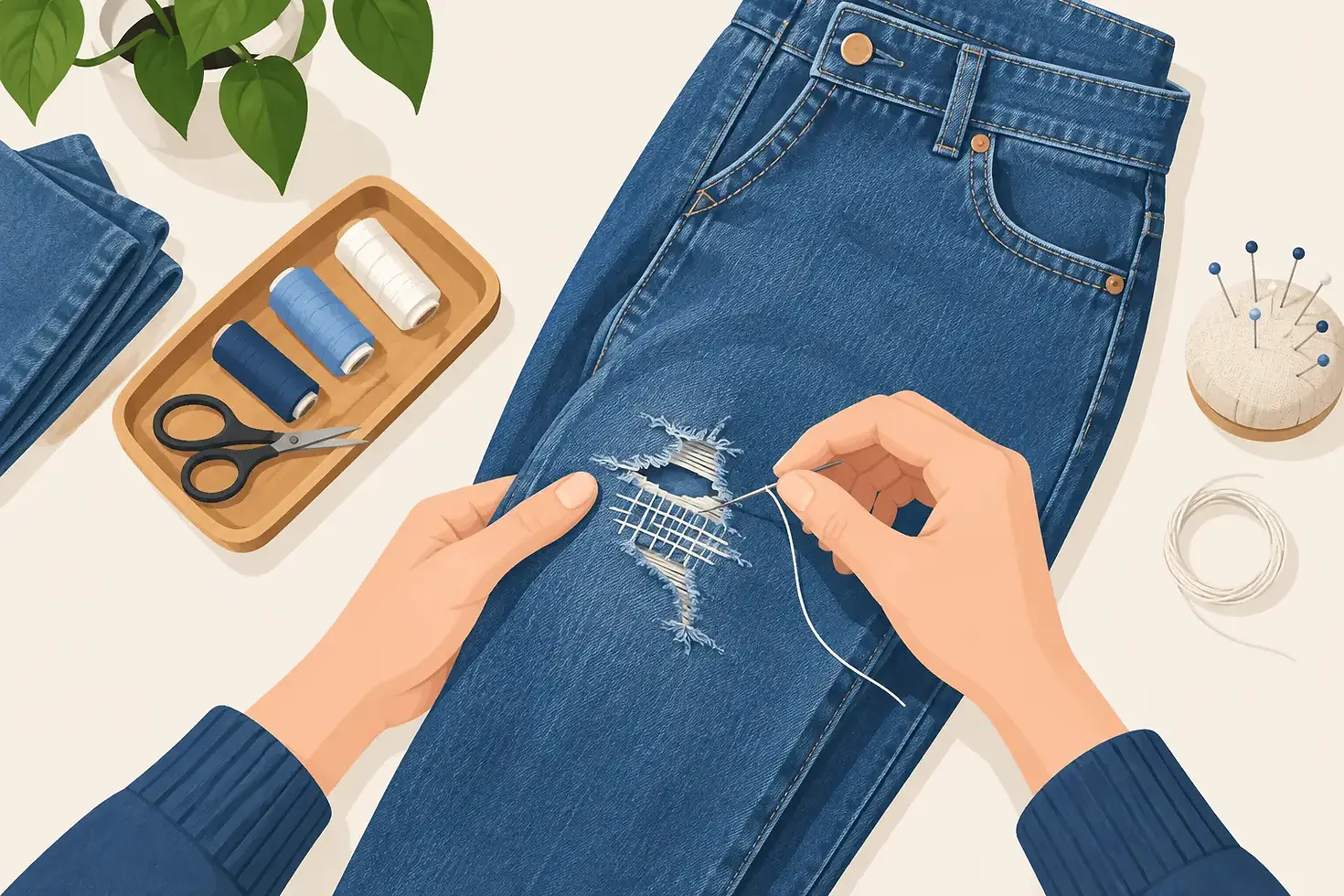
Work rows of running stitch across the tear and beyond it, moving back and forth over the damaged area. Stitch in the direction of the denim twill where possible - this is usually the diagonal texture you can see in the fabric. Continue each row at least 1 to 2 cm into the sound denim on either side. That extra stitching spreads the pressure across a wider area.
For a discreet repair, make short stitches in matching thread. For a decorative one, use larger, evenly spaced stitches in a contrasting colour. You can make parallel rows, little crosses or a simple grid. The repair will be strongest when the stitches travel across the weak fabric rather than only tracing the edge of the hole.
Finish on the inside with two small backstitches, then pass the needle through the patch for a centimetre before trimming the thread. This hides the tail and helps prevent it working loose.
If the tear is on a seam
A split seam needs a different treatment. If the denim itself is sound and only the stitching has broken, you can sew the seam back together without a patch.
Turn the jeans inside out, line up the original seam allowances and use backstitch to recreate the seam. Backstitch is strong because each new stitch overlaps the previous one. Make small, even stitches along the original seam line, then continue for 1 cm beyond each end of the split so the repair is anchored securely.
If the seam has torn through the fabric as well, add a small patch behind it before stitching the seam. This is common around the inside thigh, where friction can thin denim long before there is an obvious hole.
Choosing between an invisible and visible mend
There is no single right finish. It depends on the jeans, the location of the damage and what you enjoy wearing. A dark pair of jeans with a small rip near the pocket may suit matching thread and compact stitching. A favourite faded pair with worn knees may look even better with a contrasting patch and visible lines of thread.
A repair does not have to pretend it never happened. Denim develops personality through wear, and a carefully placed patch can add colour, texture or a small piece of fabric with a story. If you are unsure, lay different scraps behind the hole before cutting anything. Navy, indigo, calico, patterned cotton and even a fabric from an old shirt can each create a very different result.
Common hand-mending mistakes to avoid
The most common issue is making the repair too tight. Jeans need ease, particularly at the knees, seat and inner thighs. After basting the patch, gently bend the fabric in your hands before you start permanent stitches. If it feels strained, loosen the basting and reposition it.
Another mistake is using a patch that is too small. A patch only just covering the hole places all the stress along its edge. Give it room to extend into strong fabric. Likewise, do not rely on stitching around the outline of a hole alone. It may look neat initially, but the denim beside it can continue to fray.
Finally, take care when mending close to pockets, belt loops or thick side seams. Work slowly, use a thimble if you have one and avoid sewing the pocket shut by accident. Slide your hand inside the pocket before every few stitches to check where your needle is going.
Give the repair a little care
Wash repaired jeans inside out on a gentler cycle where possible, and avoid very high heat in the tumble dryer. Heat and repeated friction are hard on already-thinned denim. Check the stitched area occasionally, particularly after the first few wears. Adding a few reinforcing stitches early is much easier than waiting for the tear to grow again.
If your jeans need more than a small mend, or you would simply like someone beside you while you learn, an alteration and upcycling session at Thread The Needle Workshop can turn a pile of well-loved clothes into practical sewing experience. There is real confidence in recognising that a rip is not a failure - it is an invitation to make something useful with your own hands.


Comments